
Approaching Weil’s Writings
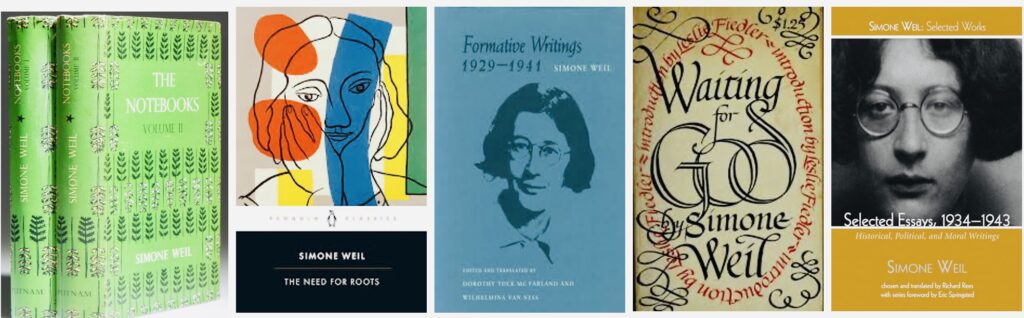
How should one read Simone Weil? Where to begin? – with her thesis on Descartes and science, her short and long essays, her thoughts on school studies, her Free French reports, her notebooks, her correspondence, her 1933-34 Roanne lecture notes, or with her play and poetry? What about which translation is truest to Weil’s words? And how should her life story fit into the study of her writings?
__________________________________________
Before continuing any further, note that two of Weil’s essays address the concept of reading, one from a philosophical perspective (“Essay on the Concept of Reading”), the other from both pedagogical and spiritual perspectives (“Reflections on the Good Use of School Studies with a View to the Love of God”).
__________________________________________
Desire and Discipline
Simone Weil, I know it even better now, is the only great spirit of our time, and I hope that those who recognize this will have enough modesty not to try to seize control of her staggering testimony. — Albert Camus, L’Express, December 18, 1955 (Benjamin Braude, trans.)
Any thoughtful reading of Weil must be born out of a desire for truth, or better still, a desire to grapple with truth as one reads the world around her and the texts before her. Also important is a willingness to be disciplined, open-minded, and free of the kind of “light candles”-like adoration common among too many of her “followers.” This is not to deny the value of her spiritual thinking, quite the contrary. Rather, it is to posit that a certain attentiveness is best suited to first reading and then reflecting on her works.
When one considers the amazing breadth of Weil’s writings – everything from her thoughts on quantum mechanics to Indian philosophy to colonialism – it is difficult to be clearheaded and avoid the dizzying effects of overload. Perhaps that explains why, in part, Gustave Thibon wrote Gravity and Grace the way he did. The result is that its brevity and abstractness are as charming as they are misleading. Unfortunately, it too often leaves readers with a sense that to understand the rich measure of Weil’s thought one needs only flea-skip through a snippet manipulated collection of her words arranged and abridged by Thibon.
- See Benjamin Braude, “Who Wrote Simone Weil’s Books?,” Boston College, Center for Christian-Jewish Learning (YouTube, March 5, 2025)
Something is also to be said for keeping a certain detached perspective when reading Weil, a willingness to test her ideas, to explore the depths of her thought, and an ability to contemplate the planes (e.g., scientific, philosophic, and transcendent) of the concepts she negotiates in developing her thoughts and how they relate to each another. A Socratic-type dialogical approach may be helpful here combined with a Platonic-like appreciation of the sublime.
For Starters
Obviously, some background knowledge of Weil’s life and times is key to any understanding of her thought. Three books (in need of republication) offer a modest, yet generally informative, introduction to Weil’s life: Richard Rees, Simone Weil: A Sketch for a Portrait (Southern Illinois Press, 1966, pp. 3-89), J.P. Little, Simone Weil: Waiting on Truth (Berg Publishers, 1988, pp. 5-49), and Robert Coles, Simone Weil: A Pilgrimage (Skylight Paths, 2001, pp. 1-21). Then there is Simone Pétrement’s massive Simone Weil: A Life (Pantheon Books, 1976).
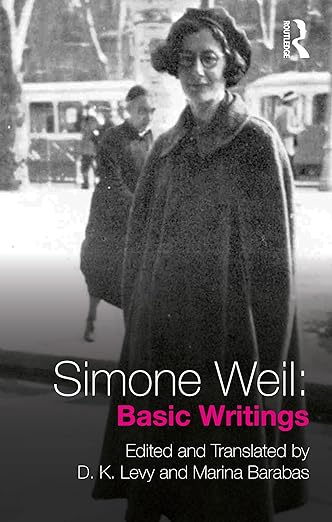
While there are several good collections of Weil’s writings (e.g., by Sian Miles, Dorothy Tuck McFarland and Wilhelmina Van Ness, Eric Springsted, and George A. Panichas), when it comes to the comprehensiveness, overall accuracy of translation, and the merit of the selections, I think the one with considerable didactic value is Simone Weil: Basic Writings (Routledge, 203), edited and translated by D.K. Levy and Marina Barabas (reviewed here). Impressive as that collection is (replete with instructive prefaces), I would have added The Iliad or Poem of Force and Weil’s essay titled “The Abolition of Political Parties.” That aside, the tripart order of Basic Writings (the human condition, non-servile work, and the transcendent) offers a thoughtful and manageable approach to Weil’s writings.
Caveat Lector
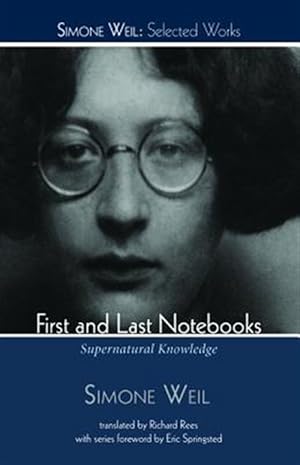
#1/ Important and valuable as they are, Weil’s notebooks should be held in respectful reserve until one has some working sense of her life, key writings, and concepts. In many ways, the notebooks are sketches of ideas Weil had, some of which were tentative and accordingly incomplete. That is, they are ideas in search of a larger thesis. For that reason, among others, Thibon’s Gravity and Grace should be avoided for its skewed and unduly abridged treatment of Weil’s notebooks.
#2/ As for Weil’s spiritual writings (especially those from 1938 and thereafter), they are, I think, best left to that point in educational time when one has some basic understanding of Weil and her thought. By way of a general comparison, beginning with Weil’s transcendent reflections would be akin to starting Plato by reading the Sophist, Theaetetus, and Parmenides – all important works, hence worthy of delayed consideration. Then again, there are certain other works, such as her reflections on The Lord’s Prayer, that more readily lend themselves to spiritual meditation.
#3/ Much of the more recent scholarship on Weil consists of comparisons of Weil’s thought with that of others (e.g., Wittgenstein and Weil). Though such works may indeed prove constructive and might even offer insightful points of contrast and comparison, too often the problem is that they demand a profound understanding of two authors and their respective nuances of thought. Moreover, something of the same holds true of the readers of such works and how much they stand to comprehend unless they, too, understand the thoughts of both authors.
Critical Perspective vs Utopian Agenda
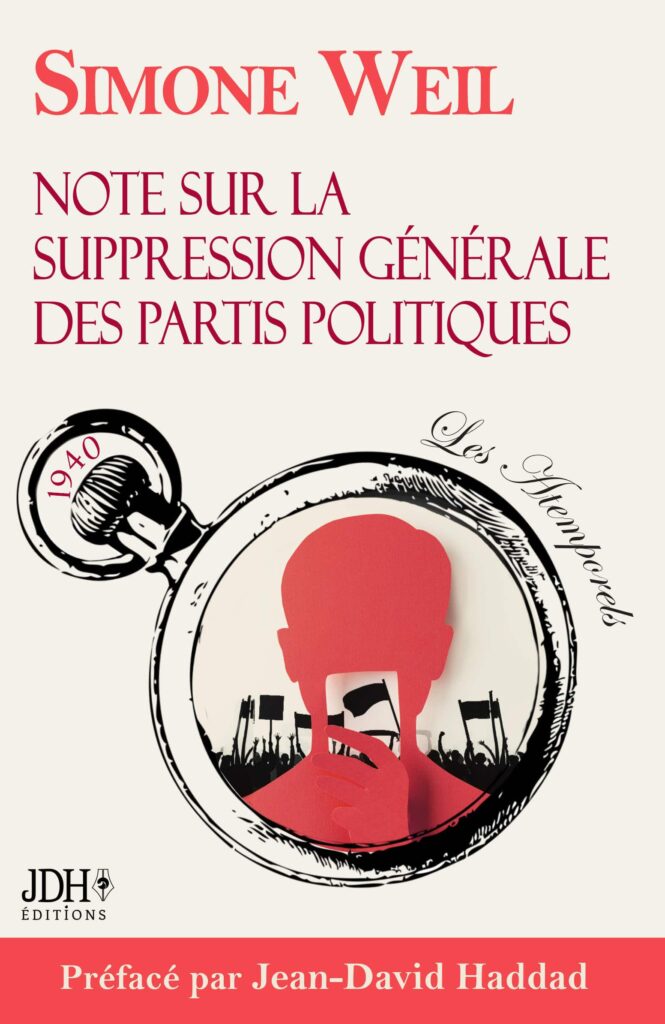
Some of Weil’s writings are invaluable as critiques of contemporary politics. Two such works are The Need for Roots (the report she prepared for the Free French) and her 1943 essay titled “The Abolition of Political Parties.” Such works provide some of the finest criticisms of modern politics. Weil’s outsider perspective, informed by illuminating thinking, is what gives such works their staying power, their ability to pierce the veil of the knee-jerk partisan politics of the moment.
In these and other works, there are insights of the kind that stand to clear the sediment clogging the minds of many. Consider, for example, the main arguments of her political party’s essay:
- Political parties are evil;
- They invite collective passions and induce members to ignore both reason and conscience;
- They use propaganda to perpetuate falsehoods beneficial to the party;
- They become ends in themselves and thus seek unlimited party power;
- They portray their own survival as an absolute good and thereby confuse means with ends; and
- They liken party interests to public interests.
Without question, this is one of the best critiques and condemnations of political parties, especially in modern America. That said, the call for the abolition of political parties is unattainable, impractical, and beyond reality. It cuts against the constitutional and structural grain of democratic republics. To be sure, such an assessment is not to devalue the worth of Weil’s thinking; it is only to underscore the real-world limits of her calls for fundamental reforms.
In reading Weil, one must heed her admonition, one penned to her parents on August 4, 1943, weeks before her death:
“The eulogies of my intelligence are privately intended to evade the question: ‘Is what she says true?’” (italics in original).
Mindful of that, readers of her words must not “evade” that advice.
Secondary Works
Finally, secondary works can be helpful provided they do not replace any engaged examination of Weil’s own writings. In this regard, it is well to echo something Leo Strauss wrote nearly six decades ago: “Liberal education consists in studying with the proper care the great books which the greatest minds have left behind” (itals. added). That is, liberal education, thus understood, “is the counterpoison to mass culture, to the corroding effects of mass culture . . . .” The takeaway: Start with a careful study of original works before turning to commentaries as shortcuts to understanding great thinkers. Thus understood, some of the more instructive commentaries on Weil’s thought include:
- Robert Chenavier, Simone Weil: Attention to the Real (University of Notre Dame Press, 2012)
- E. Jane Doering, Simone Weil and the Specter of Self-Perpetuating Force, University of Notre Dame Press, 2010)
- Palle Yourgrau, Simone Weil (Reaktion Books, 2011)
- Peter Winch, Simone Weil: “The Just Balance” (Cambridge University Press, 1989)
- Rush Rhees, Discussions of Simone Weil, D.Z. Phillips, ed. (SUNY, 2000)
- Mary Dietz, Between the Human and the Divine: The Political Thought of Simone Weil (Rowman & Littlefield, 1988)
- Eric Springsted, Simone Weil for the Twenty-First Century (University of Notre Dame Press, 2021)
- Lawrence Blum & Victor Seidler, A Truer Liberty: Simone Weil and Marxism (Routledge, 1989)
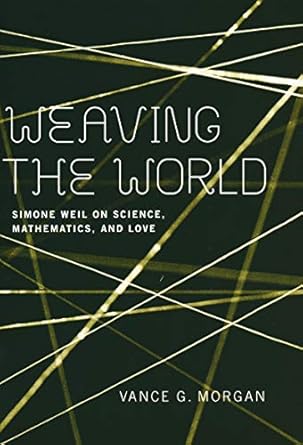
- Vance Morgan, Weaving the World: Simone Weil on Science, Mathematics, and Love (University of Notre Dame Press, 2005)
- Lisa McCullough, The Religious Philosophy of Simone Weil: An Introduction (I.B. Tauris, 2014)
- Richard Bell, editor, Bell, Simone Weil’s Philosophy of Culture: Readings Toward a Divine Humanity (Cambridge University Press, 1993).
