
Book Review: Simone Weil: A Life in Letters
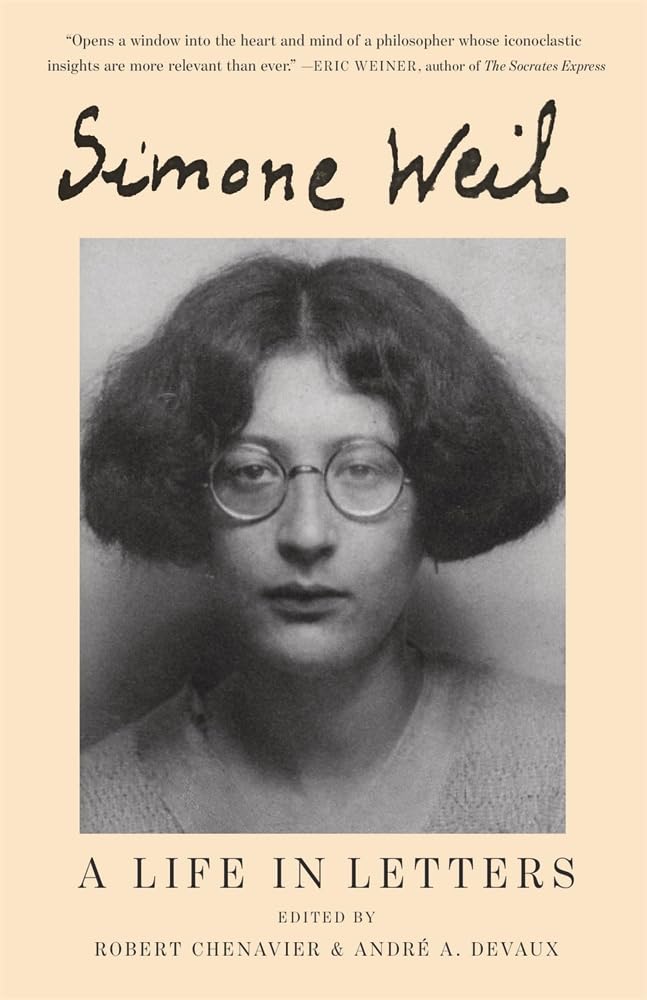
Simone Weil: A Life in Letters. Edited by Robert Chenavier and André A. Devaux. Translated by Nicholas Elliott. Cambridge: Harvard University Press, 2024. 362+xvi pages.
The first volume of the Œuvres complètes of Simone Weil appeared in 1988, the most recent, the thirteenth volume, in 2019. Two remain to come – Weil’s non-familial correspondence, and her poetry and unfinished play, Venise Sauvée. I have long wished for an English translation of all these volumes with their remarkable scholarly apparatus. And, if not all of them, then at least some of the most significant ones: her last writings from New York and London, many of which still have not been translated; or the truly remarkable writings from Marseille; or the complete Cahiers. Any of these would be a very big undertaking, but with great rewards. But there is little likelihood that it will happen in any foreseeable future.
Surprise publication
All of which makes it a surprise to see Harvard University Press publish this volume, a translation of the Œuvres complètes VII.1, Weil’s correspondence with her family. It is, first, a surprise to see it at all. It is also a bit of a surprise that this volume was the one that got translated and published. It is not clear why it was chosen.
Despite the claim on the dust jacket that this book is “an ideal entryway into Weil’s philosophical insights,” it is nothing of the sort. It isn’t even an ideal entryway into her biography. Knowing something about her biography ahead of time makes it much easier to follow the correspondence. This, however, is an essential book for anyone who wants to delve deeply into her biography and actually use evidence.
A “Wonderful Addition”
But so be it. There is nothing to complain about here on the merits. For those interested in Weil, this is a wonderful addition to the existing primary material in translation. The correspondence – and it is only the letters Simone wrote, none of the ones she received – is divided into three parts:
- “First Letters,” which cover the letters of the very young Simone;
- Second, letters to her parents Selma and Bernard, from 1926 to the last letter before she died in 1943; and
- Finally, the letters she wrote to her brother, André from 1932-1943.
All of these letters might be very difficult to navigate were it not for the extremely thorough footnotes of the editorial team. All historical and personal references are explained. Robert Chenavier provides an insightful and sensitive introduction.
Revealing Letters
The value of these letters is that they offer a look into the Weil family’s life together and show something of Simone’s personal growth. The Weil family were letter writers. When apart, it was expected that they would each write frequently, if not daily. Observations about not having received a letter recently, or apologies for not having sent one, are pretty constant. The letters, for the most part, are not deeply intimate but full of news, a lot of concern for each other, and a lot of teasing.
For all the starkness of the lines used to portray Simone Weil as a person, we see her here as far more normal than her biographers often portray her. Not that there aren’t a lot of obvious quirks, though. After Simone graduated from the Ecole Normale and took up her first teaching post in Le Puy in 1931, the correspondence is filled with demands and requests.
Often, biographers love to repeat stories of Simone’s lack of attention to the details of daily life and of how her mother, in particular, sought, sometimes secretly, to take care of her – money in her account, food in the cupboard, rent, etc. Simone was aware of a lot of that, and tried to get her mother to back off. But there were also a lot of demands and requests – send my bike (this goes on over several letters), send these books, contribute to these causes, go see this person. Frankly, I would have been astonished to get letters like this from any of my daughters, even if she were twenty-two and starting a new job. Adults, even young ones, should learn to depend on themselves. But one also gets the sense that her parents played a role in this. And it seems that they were involved in her many causes of their own volition.
But, with that said, this sort of letter eventually ceases. Some of the reasons must have been that Simone left behind her political involvements, which had made for a dizzying schedule of commitments. But she also seemed to mature. Her letters from Italy, a trip that was a high point of her life, show an indefatigable will to see and experience things, and she seemed to manage the arrangements all by herself. Her time spent at Gustave Thibon’s farm also shows self-sufficiency. She could cook for herself.
Letters from London
Her letters from London are also particularly remarkable. They are newsy, they express her regret at ever having left France, and they are filled with observations about England, which she loved. But they are heartrending, too, since from April until her death in August of 1943, she kept up with the news and the observations, although she went nowhere, being confined to a hospital bed. She never let her family know how sick she was, knowing that across an ocean, there was nothing they could do, and they would want to do everything.
There is little philosophy in these letters. They never mention her significant religious experiences. However, in her letters to her brother, there are some important philosophical reflections. In 1941, while in Marseille, Simone was intensely interested in problems of contemporary science, and ancient Greek mathematics. Her correspondence with her world-renowned mathematician brother reveals a lot of her reflections on these matters. Some of this has been seen in excerpts from these letters in Richard Rees’ Seventy Letters. Here, however, we finally have the whole letters, as well as several drafts and unsent ones. Again, unfortunately, we do not have André’s responses.
These letters are many things. It is a gift to have all of them, and in such an accessible way.

Eric Springsted is on Attention’s Advisory Board. His last book on Weil was Simone Weil for the Twenty-First Century (University of Notre Dame Press, 2021). He is also the co-editor of A Declaration of Duties toward Humankind: A Critical Companion to Simone Weil’s The Need for Roots (Carolina Academic Press, 2024).
5 Recommendations