
Inside Issue 13: New Blood, New Books, and New Articles

If it is to stay alive and vibrant, every publication must inject new life blood into its system. So, too, with this publication. By that measure, we are delighted to bring two young and able scholars onto our Advisory Board. Even at their youthful ages, Dr. Kathryn Lawson and Dr. Michela Dianetti are busy paving a future in Weilian studies.

Kate Lawson (Ph.D. in Philosophy, Queen’s University) is currently a Faculty Fellow at King’s University College in Halifax and will be joining the philosophy department at the University of Winnipeg as a full time Instructor in fall of 2026. As a lecturer, Kate seeks to bring together rigorous scholarship in the history of philosophy, exploration of burgeoning thinkers, and passionate engagement with how philosophical ideas are relevant to student’s lives. Kate’s research interests include social and political thought, continental philosophy, aesthetics, philosophy of religion, phenomenology, Indian philosophy, existentialism, and ecological ethics. She is the author of Ecological Ethics and the Philosophy of Simone Weil: Decreation for the Anthropocene (2024), and co-editor of Hannah Arendt and Simone Weil: Unprecedented Conversations (2024), and Breached Horizons: The Philosophy of Jean-Luc Marion (2017) and has contributed to recent Weil collections including: The Routledge Companion to Simone Weil, The Bloomsbury Handbook of Simone Weil, and Rethinking Political Crisis and Collapse: Hannah Arendt and Simone Weil. She is a board member of the American Weil Society and runs their Simone Weil virtual reading group, graduate student Weil workshops, and is orchestrating their 2026 online conference.
- “The Life and Philosophy of Simone Weil with Dr. Kathryn Lawson,” The Young Idealist (2025) (podcast interview)
Michela Dianetti (PhD in Philosophy, University of Galway). Dr Dianetti is a Postdoctoral researcher in Philosophy at the University of Galway, with her project AND (Art needs Dialogue) in collaboration with Baboró International Arts Festival for Children, where she is developing an audience engagement project through the Philosophy for Children (P4C) pedagogy. Her P4C facilitation practice is strongly influenced by the idea of an ‘attentive education’ present in Weil’s philosophy (See her publications “From desiring to inquiring:“setting the stage for attention” through philosophical dialogue,” Attention (Jan. 2025, with Lucy Elvis), and ‘Attending to Adolescence Experience through Greek Tragedies’ with Elvis, 2024). She is currently researching the influence of Weil’s philosophy on one of the founders of P4C, Ann Maragret Sharp, and how to develop an ‘attentive education’ (‘Emotion, Disequilibrium and Attentive Compassion. Confronting Emotions in the Community of Philosophical Inquiry with Simone Weil & Ann Margaret Sharp’ with Elvis, 2025). Her PhD research developed a literary ethics of attention grounded in Simone Weil, Iris Murdoch, and Elsa Morante (Against Unreality). She is the co-founder of AIREResearch Collective, a Weil-inspired collective that focuses on public philosophy, art, and environment and advocates for a non-individualistic, collaborative, and caring way of doing academic research. She is a board member of the Irish Philosophical Society and the awardee of the NUI Postdoctoral fellowship in Humanities & Social Sciences 2025 for her project ALEPH (Attentive Literary Education through Philosophy). Some of her other writings include: ‘Climate Crisis as a Matter of Inattention: Practising Shared Attention to Invisible Beauty’, (co-authored with AIRE, 2026); ‘From Becoming to Stillness: Posthuman Mysticism in Alice Rohrwacher’s Happy as Lazzaro’ (with Chiara Li Mandri, 2026); ‘Exploring the connection between attention and literature through Simone Weil and Iris Murdoch’ (2023) (More details on her publications Here).
Forthcoming Book
- Deborah Casewell & Christopher Thomas, eds., The Routledge Companion to Simone Weil (Routledge, July 2, 2026)
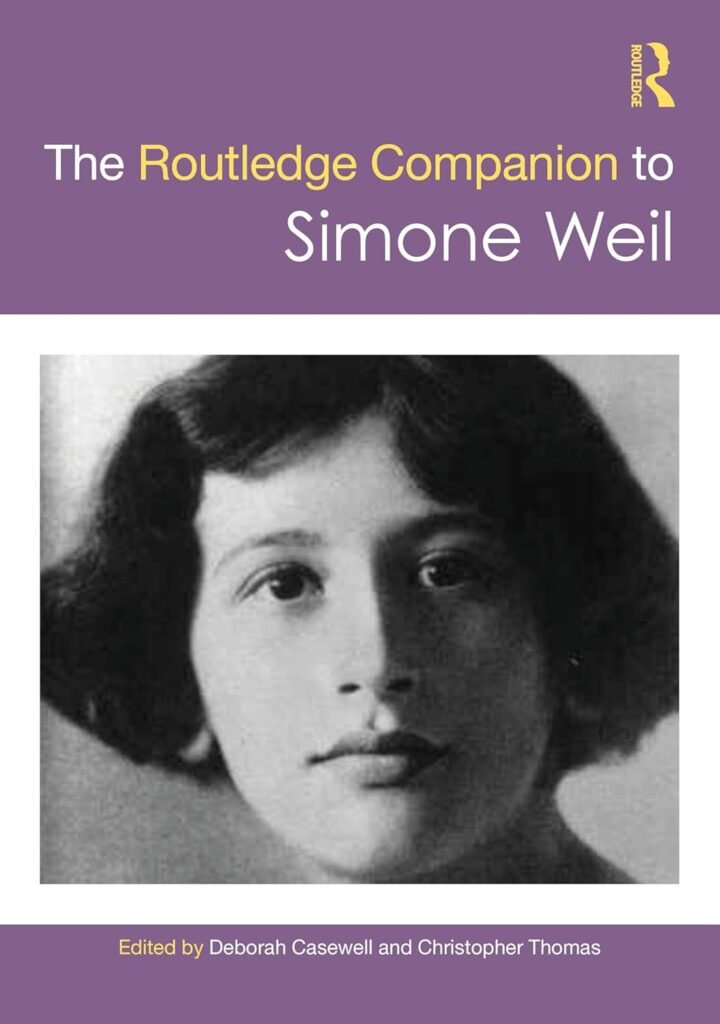
The remarkable life and work of the French philosopher and activist Simone Weil has fascinated scholars from many disciplines, with no less than Albert Camus calling her the ‘only great spirit of our times’. Although contemporaneous with the rise of existentialism, and educated alongside contemporaries such as Simone de Beauvoir, Jean-Paul Sartre, and Maurice Merleau-Ponty, the creative and restless nature of Weil’s thought set her apart. Equally adept at thinking across politics, philosophy, theology, ethics, literature, and science, Weil stands distinct in the canon of twentieth-century Western thought as a highly unique and controversial figure.
The Routledge Companion to Simone Weil is an outstanding survey of her thought. Thirty-seven chapters by an international team of expert contributors are divided into six clear parts:
- Contextualising Weil
- Philosophical Sources
- Key Concepts
- Politics and Society
- Interactions with Religion
- Conversations.
Within these sections key thinkers and topics central to Weil’s philosophy are addressed, including Plato, Kant, Marx, God, attention, love, beauty, labour and work, the body, slavery, rootedness, colonialism, fascism, Catholicism, Judaism, Indic thought, phenomenology, existentialism, feminism, literature, and many more.
The Routledge Companion to Simone Weil is an invaluable resource for anyone studying or researching Weil’s thought, whether in philosophy and religious studies or related disciplines such as political theory, French literature and Jewish studies.
Two New Books
- Antonio Calcagno, ed., Rethinking Political Crisis and Collapse: Hannah Arendt and Simone Weil (Bloomsbury Academic, Jan. 8, 2026)
Responses, both critical and constructive, to changing realities in modern politics and society. In gathering these essays, Antonio Calcagno and Mark Yenson have chosen the conceptual lens of crisis and collapse, not in the spirit of lamenting or decrying the death of a once-enjoyed, but now lost, state of affairs. Rather, they seek to understand what the concepts of crisis and collapse mean, how they are deployed in various situations, and how they are used to explain shifts in politics and society.
The contributing scholars featured in this volume demonstrate how two important political thinkers imagined new worlds and social orders that could arise from significant change brought on by forms of crisis and collapse. Through their work, Hannah Arendt and Simone Weil offer new generative visions of what it is to be human in a time when our very understanding of humanity is changing.
Related
- Kathryn Lawson, Hannah Arendt and Simone Weil: Unprecedented Conversations (Bloomsbury Academic, 2025)
- Yvanka Raynova, ed., Simone Weil (1909-1943) Receptions and Actuality, Part 1: Simone Weil’s Social and Political Thought (2025, Axia Academic Publishers)
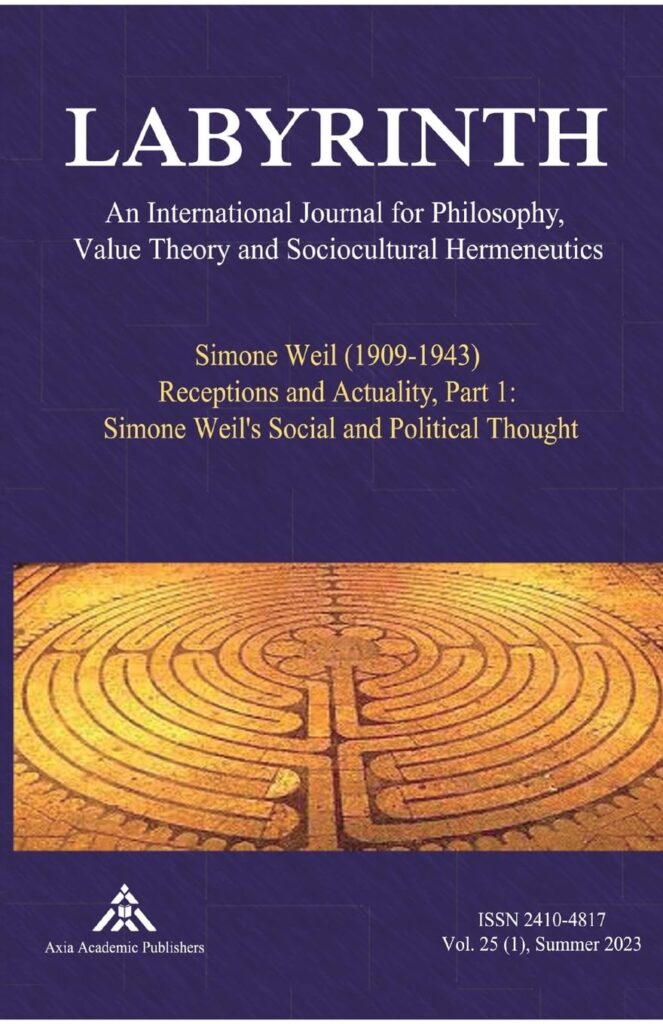
Rereading Simone Weil today, now that her work has been published in its entirety and has been the subject of numerous in-depth studies, is a difficult task. Specially, when one considers that her philosophical and methodological approach is difficult to determine. Weil draws on the thinking of various philosophers, not blindly, but always with a certain distance, and therefore does not belong to any philosophical school, just as her faith does not belong to any denomination.
In the following two volumes, we chose to approach Weil’s work by focusing on two aspects of her work: the physical and spiritual needs. The first part of the publication explores the continuing relevance of Simone Weil’s social and political ideas, while the second part highlights her legacy in ethical theory, aesthetics, mathematics, and her contribution to an open, non-denominational spirituality. The diversity of the essays clearly demonstrates the enduring inspiration that Weil’s work provides for philosophers of all kinds, or, as Gustave Thibon once puts it, a ‘light for the mind and nourishment for the soul’ for those who are ready to receive it.
New Articles
- Alain Supiot, “Between Alienation and Ecstasy: Simone Weil’s degrees of attention,” CLT (Jan. 13, 2025). (In two letters written shortly before she sailed from Marseille in May 1942, Simone Weil reveals the profound impact George Herbert’s ‘Love’ (now commonly titled ‘Love (III)’) had on her. When reciting the poem to herself during intense headaches, she had a religious experience which involved Christ descending and taking possession of her. This article offers a comparative case study of how focused attention on poetry can become a form of prayer leading to religious experience. It offers a close reading of ‘Love’ through the lens of Weil’s philosophical and spiritual writings from the last year of her life. For Weil, the beauty of poetry is analogous to the beauty of the world and hence can indicate God’s will or the ineffable order of the universe.)

- Cécile Ezvan, “Principles and Limits of Freedom of Expression, Simone Weil’s Ethical Insights,” Link (Jan. 23, 2025) (This article presents the results of a journey into the work of French philosopher Simone Weil, Oppression and liberty and The Need for roots, in order to identify the conditions and limits to the implementation of freedom of expression. This research project aims at identifying the ethical foundations of freedom of expression in a contemporary context where globalization, the media and social networks facilitate a fast dissemination of numerous individual and collective expressions, while the law cannot discern when to privilege freedom of expression over other human rights. The result of our analysis of Weil notions of “need of the soul” and “obligations towards human being” enable to understand why freedom of expression is individual and not collective and under which conditions it should be protected: as an essential need of our intelligence, rooted in every human being, that must be respected absolutely at an individual level. This principle also makes it possible to legitimize the limitation of certain collective expressions conveyed by organizations, in their external and internal communication, and the authorization of the individual voice of certain stakeholders when they speak out in favor of justice and truth.)
- Eric Springsted, “Simone Weil and Ludwig Wittgenstein: ‘Philosophy as work on oneself’,” Philosophical Investigations (Nov. 11, 2024) ((For many years Simone Weil and Ludwig Wittgenstein have been placed side by side. Little of that work has tried to explicitly compare the two. Direct comparisons can, however, be made between Weil and Wittgenstein, which can show that the ways they approached philosophy shared numerous traits and ideas. Both thinkers rejected philosophical systems, both admitted that serious philosophical work did not try to reject all contradictions internal to it, and, in fact, both sought to make facing contradictions and seeming contradictions central to their method. Both wrote of the world with a sense of mystery that surrounds human life, a sense of transcendent good. Both engaged the problems with talking about such a good that cannot be neatly fit into language. Both also saw the task of philosophy as one concerned with meaning. Both also saw philosophy as a matter of “work on oneself.” This essay will examine what it means to say that philosophy is a matter of work on oneself. To do so, I want to examine primarily two essays, one from each philosopher, essays which bear remarkable similarity to each other in the sort of problem they deal with.They are section xi of Wittgenstein’s Philosophy of Psychology – A Fragment, and Weil’s “Essay on the Concept of Reading.”)
New PhD Dissertation
- Rachel Matheson, “The Madness of Love: Simone Weil’s Kenotic Theology of Decreation,” McMaster University (Religious Studies, 2025)

This dissertation examines the notion of “decreation” in the thought of the French philosopher and mystic, Simone Weil. Although the term is ambiguous and contested, I argue that the kenotic hymn of Philippians 2 is crucial to understanding the concept and the related vocabulary of renunciation, sacrifice, obedience, slavery, and selflessness in her thought. Weil presents an incisive critique of modernity and the Christian culture within it that calls into question sovereignty and power as divine attributes to be emulated, and that turns instead to the alternative model of relation found in the radical and “mad” love of Christ’s self-emptying servanthood.
I begin by examining Weil’s mystical reading of three of Plato’s dialogues (Symposium, Republic, Phaedrus), focusing on her interpretations of several images, speeches, and myths that clarify her understanding of the dynamics of love and force. I then turn to Marguerite Porete’s 14th century dialogue, The Mirror of Simple Souls, to suggest that Porete’s account of the soul’s annihilation in Love illuminates Weil’s concept of decreation. Finally, I consider how Weil imagined decreation might be embodied in her own time through what she calls the “spirituality of work,” which she presents as an alternative to the empire of force in her final text, The Need for Roots. Weil believed that given the right conditions, labour could become an ascetic practice through which the “I” is relinquished in a mutual servanthood that simultaneously “roots” one in the world. Through my analysis, I argue that the mystical, kenotic shape of Weil’s theology offers an account of how radical self-effacement might inform a politics of resistance to contemporary expressions of power, force, and empire.
In Case You Missed These Podcasts
- “The Philosophy of Simone Weil with Kenny Novis and David Levy,” Lepht Hand (Oct. 17, 2024) (podcast) (In this episode of Acid Horizon, Will takes the lead as host, welcoming Kenny Novis and special guest David Levy. David, a philosophy professor at the University of Edinburgh and one of the translators and editors of Simone Weil: Basic Writings, joins the conversation. Simone Weil, the renowned French mystic and political activist, has influenced a broad range of thinkers. Today, we explore Weil’s key concepts, such as decreation, her moral philosophy, and her critique of colonialism.)
- “The Literary Afterlives of Simone Weil with Dr. Cynthia Wallace,” Chasing Leviathan (podcast, 2025) (On this episode of Chasing Leviathan, PJ and Dr. Cynthia R. Wallace discuss the contradictions and impact of Simone Weil’s life and work. Dr. Wallace explores the importance of embodiment in Weil’s philosophy and the connection between obligations and the body. She highlights the impact of Weil’s Christian convictions, particularly those related to self-sacrifice, and how they led to both pathways for deep connection with others and self-destructive behavior in Weil’s own life. Dr. Wallace encourages us to reflect on creative tension, suffering, and the demand for change in encountering the other.)
