
Ellul and Weil: Attention as Waiting: Complementary Critiques in an Age of Technique via Simone Weil and Jacques Ellul
Excerpt:
The writings of Simone Weil and Jacques Ellul include sociological, philosophical, and religious themes, and the two intellectuals serve as “bookends” surrounding the postmodern era. The writers were prolific, respectively, during the time between the World Wars (Weil), and the late 20th century’s Information Age (Ellul). They each dealt with the impact of modernity on humans, further exploring the implications of Weber’s definition of moderns as “sensualists without heart and specialists without spirit.”
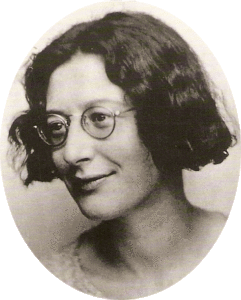 Weil and Ellul had prescient insights on a contemporary trend, namely an unbridled faith in technology, or what Ellul called “technique,” looming large. Ellul and Weil both present a case for how the method of the technological imagination undermines basic needs and obligations for human beings. Alan Jacobs’ text discusses both Weil and Ellul in this light. For Weil the enemy of education is “technocracy . . . ’evil [dominates] wherever the technical side of things is…sovereign.” For Ellul, observing later in the 20th century, “education no longer has a humanist…value in itself; it has only one goal, to create technicians.” Combining these reflections from the two authors, postmodernity and techniquelose touch with what Weil calls “attention”—waiting for God (or Platonist transcendent claims of Truth and Goodness), and also to the human other.
The thrust of technique in the contemporary American spheres of social media and education pulls away from critical and reflexive capacities, especially as core values in the liberal arts. These two related spheres of change suggest the unreflective assertion of ideas without in-depth, historical learning, or an ethically-entrenched humanistic approach. Higher education and wider communities of discourse reflect an age of empty speech and the worship of technological innovation and “the newest.” This moves away from the charism of St. Bernard of Chartres who reminds us that “New knowledge is always standing on the shoulders of giants.”
Source: International Jacques Ellul Society (2022) / / An early version of this article was presented at the American Weil Society colloquy in the Spring of 2017 at Villanova University.
Sarah MacMillen is an associate professor at McAnulty College and Graduate School of Liberal Arts in the Sociology Department at Duquesne University.
