
Simone Weil’s Notion of Reading for the Love of Others
Waseda University, Japan.
Waseda University, Japan.
Commentary, vol. XI, pp. 36-46
NPR
Abstract
This dissertation places literature and myth at the suture of two of Simone Weil’s most important concepts: decreation and metaxu. Decreation, or the decanting of subjectivity to become one with God, has become a fixture in Weil scholarship. Yet, the link between decreation and metaxu, the bridges that collapse self and other, has yet to be theorized. This study brings metaxu to the forefront of Weil studies to emphasize its role within the domains of community and culture, thereby signaling its unseen potential to harmonize the political and mystical strains of her thought. I counter decreation’s salvific consolation with metaxu’s radical materialism and its privileging of hybridity, relationality, and metamorphosis. Weil’s writing combines a critique of capitalism (the hegemonic gros animal) with a frequent entanglement of Greek and Christian myth. A discussion of metaxu is brought to bear on literary revisions of classical myths from the 1980s and 1990s, an important peak in capitalism’s global dominance. My work sets into a motion a metaxic hermeneutic to investigate literary revisions of myths of transcendence, but also transcendence as a key myth challenged by late-twentieth-century literature.
In Chapter 1, I outline the importance of metaxu to Weil’s writings on mysticism and locate its roots in Platonic philosophy, Greek Tragedy, and the myth of Prometheus—the subject of her most important (but nearly forgotten) poem. In Chapter 2, I analyze metaxu’s relationship to specific iterations of violence and sacrality in Weil’s “The Iliad: or the Poem of Force” (1939) and Cormac McCarthy’s Blood Meridian (1985), which I interpret as an Americanized retelling of Homer’s epic. In Chapter 3, I locate metaxu’s connection to art and neoliberal globalism through Salman Rushdie’s The Ground Beneath Her Feet (1999). Chapter 4 applies metaxu to issues of metamorphosis and hybridity through Octavia Butler’s Dawn (1987). Butlerdeconstructs notions of mysticism, eroticism, otherness, and species that are to be read against the patriarchal aesthetics of Homer, McCarthy, and Rushdie. By reading these texts together, a subversive and disruptive potential for metaxu will be revealed, one that heralds an important re-reading of Weil’s oeuvre, as well as an ability to reshape the intersection of literature, myth, and mysticism.
_______________
A dissertation submitted to the Faculty of Graduate Studies in partial fulfillment of the requirements for the degree of Doctor of Philosophy, Graduate Program in English, York University Toronto, Ontario September 2021
“The inspiring letters of philosopher, mystic, and freedom fighter Simone Weil to her family, presented for the first time in English.
Now in the pantheon of great thinkers, Simone Weil (1909–1943) lived largely in the shadows, searching for her spiritual home while bearing witness to the violence that devastated Europe twice in her brief lifetime. The letters she wrote to her parents and brother from childhood onward chart her intellectual range as well as her itinerancy and ever-shifting preoccupations, revealing the singular personality at the heart of her brilliant essays.
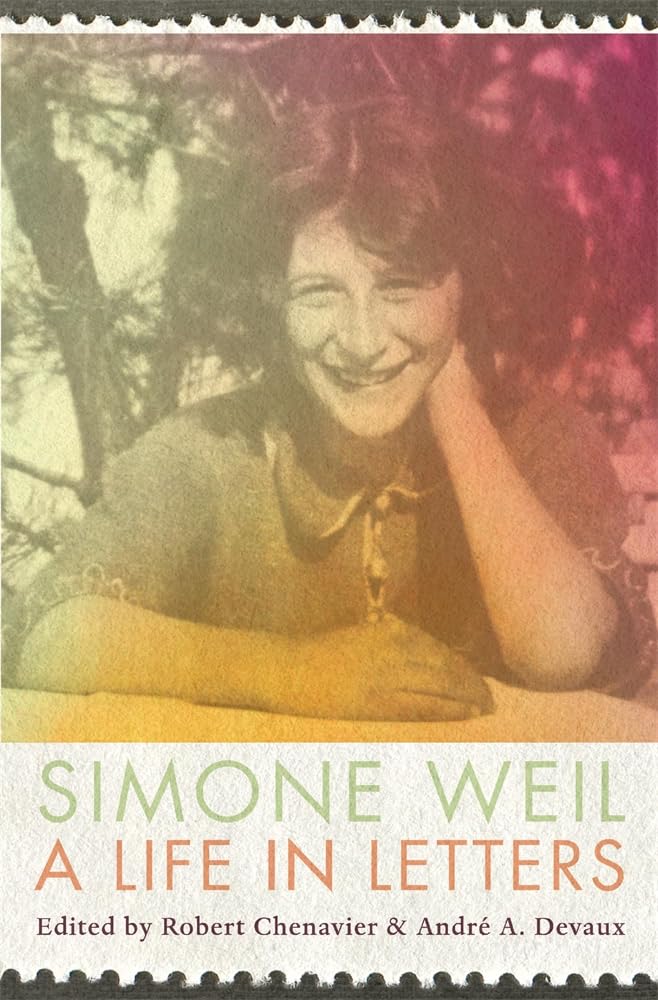
The first complete collection of Weil’s missives to her family, A Life in Letters offers new insight into her personal relationships and experiences. The letters abound with vivid illustrations of a life marked by wisdom as much as seeking. The daughter of a bourgeois Parisian Jewish family, Weil was a troublemaking idealist who preferred the company of miners and Russian exiles to that of her peers. An extraordinary scholar of history and politics, she ultimately found a home in Christian mysticism. Weil paired teaching with poetry and even dabbled in mathematics, as evidenced by her correspondence with her brother, André, who won the Kyoto Prize in 1994 for the famed Weil Conjectures.
A Life in Letters depicts Simone Weil’s thought taking shape amid political turmoil, as she describes her participation in the Spanish struggle against fascism and in the transatlantic resistance to the Nazis. An introduction and notes by Robert Chenavier contextualize the letters historically and intellectually, relating Weil’s letters to her general body of writing. This book is an ideal entryway into Weil’s philosophical insights, one for both neophytes and acolytes to treasure.”
in Richard H. Bell, ed., Simone Weil’s Philosophy of Culture: Readings Toward Divine Humanity, New York: Cambridge University Press, pp. 150-158
Arthur Wills trans., New York: Routledge
There is one thread of thought no serious reader of Simone Weil can possibly miss from the variegated tapestry of her thinking. And that is her sense of God, which is almost naturally embedded therein. She unfailingly elevates her every insight to a level that is at once metaphysical or theological. Indeed, Weil considers all human concerns always “situated in the context of our relation to God.” She excludes nothing for she believes that even those practices not readily recognized as religious contribute to our spiritual development and prepare us for loving God. . . .
Logos: A Journal of Catholic Thought and Culture, vol, 9, no. 1, Winter 2006, pp. 127-144
in Dunaway, John M. & Springsted, Eric. O., The Beauty that Saves: Essays on Aesthetics and Language in Simone Weil, Macon, GA: Mercer University Press, pp. 99-107
