
Semantics of the Unspeakable: Six Sentences by Simone Weil
Trajectories of Mysticism in Theory and Literature, (n.d.) pp. 72-93
Trajectories of Mysticism in Theory and Literature, (n.d.) pp. 72-93
Northwestern University
Arthur Wills trans., New York: Routledge (1956)
“The inspiring letters of philosopher, mystic, and freedom fighter Simone Weil to her family, presented for the first time in English.
Now in the pantheon of great thinkers, Simone Weil (1909–1943) lived largely in the shadows, searching for her spiritual home while bearing witness to the violence that devastated Europe twice in her brief lifetime. The letters she wrote to her parents and brother from childhood onward chart her intellectual range as well as her itinerancy and ever-shifting preoccupations, revealing the singular personality at the heart of her brilliant essays.
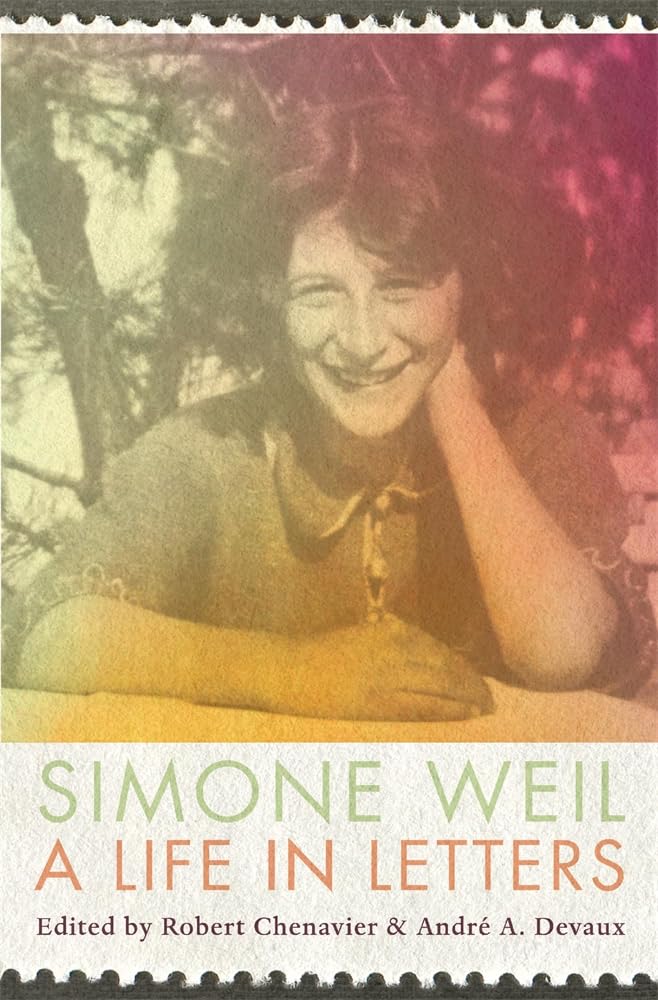
The first complete collection of Weil’s missives to her family, A Life in Letters offers new insight into her personal relationships and experiences. The letters abound with vivid illustrations of a life marked by wisdom as much as seeking. The daughter of a bourgeois Parisian Jewish family, Weil was a troublemaking idealist who preferred the company of miners and Russian exiles to that of her peers. An extraordinary scholar of history and politics, she ultimately found a home in Christian mysticism. Weil paired teaching with poetry and even dabbled in mathematics, as evidenced by her correspondence with her brother, André, who won the Kyoto Prize in 1994 for the famed Weil Conjectures.
A Life in Letters depicts Simone Weil’s thought taking shape amid political turmoil, as she describes her participation in the Spanish struggle against fascism and in the transatlantic resistance to the Nazis. An introduction and notes by Robert Chenavier contextualize the letters historically and intellectually, relating Weil’s letters to her general body of writing. This book is an ideal entryway into Weil’s philosophical insights, one for both neophytes and acolytes to treasure.”
Washington Independent Review of Books
Clip from the documentary written, directed & produced by Julia Haslett
Simone Weil in her essay “Human Personality,” asks her audience to think about liberalism’s response to Nazi Germany through the “United Nations Declaration of Human Rights,” posed as a struggle between the personal and the impersonal. Weil was a notable Marxist, and was a Catholic who never joined the Church; she lived and thought in liminality. Weil’s work as a political theologian is often forgotten; however, her critique of liberalism resonates in a world in which responses to neoliberalism are often a calling back to liberalism.
Epoché, no. 34.
Excerpt:
Almost twenty years have passed since my father’s death on August 6th, 1998, yet he still sometimes calls me: “Sylvie, get me out of here, I’m bored.” (The French word he uses is not so polite.)
I am sure that, following Jewish tradition, André was assigned a study companion for all eternity. I had once asked him who this companion would be. “Euler,” he answered, and smiled. So when he calls me to tell me he is bored, I ask: “What about Euler? Is he bored, too?”
Nothing horrified my father more than being bored or wasting time. Every moment needed to be usefully or pleasantly employed. I still have my father’s letters to me when I was a teenager. He recommended extraordinary programs: evenings were given to reading Euripides and Sophocles, Thursdays at the Louvre or the Comédie Française, Sunday afternoons at the Salle Pleyel to hear Beethoven…. The idealism of these letters makes me smile, but reactivates the terrible guilt I felt because, at fifteen, I just wanted to have a good time.
Communication, vol. 65, no. 1, Jan. 2018, pp. 54-57
Hanover, NH: University Press of New England
in Death, Dying and Mysticism, Christopher Moreman & Thomas Cattoi, eds. New York: Palgrave-Macmillan
