
Commentary on The Iliad or Poem of Force (part 1)
— Part 2 here
Dr. Andy Amato is an Associate Professor of Instruction – Philosophy at the University of Texas at Dallas.
— Part 2 here
Dr. Andy Amato is an Associate Professor of Instruction – Philosophy at the University of Texas at Dallas.
Attending – patient contemplation focused on a particular being – is a central ethical activity that has not been recognized by any of the main moral systems in the European philosophical tradition. That tradition has imagined that the moral agent is primarily a problem solver and world changer when what might be needed most is a witness.
Moral theory has been agonized by dualism – motivation is analyzed into beliefs and desires, descriptions of facts and dissatisfactions with them, while action is represented as an effort to lessen dissatisfaction by altering the empirical world. In Attending Warren Heiti traces an alternative genealogy of ethics, drawing from the Platonism recovered by Simone Weil and developed in the work of Iris Murdoch, John McDowell, and Jan Zwicky. According to Weil, virtue is knowledge, knowledge is embodied, and the knower is nested in an ecosystem of relationships. Instead of analyzing and solving theoretical problems, Heiti aims to clarify the terrain by setting up objects of attention from more than one discipline, including not only philosophy but also literature, psychology, film, and visual art.
The traditional picture captures one important type of ethical activity: faced with a moral problem, one looks to a general rule to furnish the solution. But not all problems conform to this model. Heiti offers an alternative: to see what is needed, one attends to the particular being.
Warren Heiti is a Professor of philosophy and liberal studies at Vancouver Island University.
McGill-Queen’s University Press, July 15, 2021
Abstract: Decreation is one of the central ideas in Simone Weil’s mysticism that first was introduced by her into the theological and mystical discourse of Christianity. Understanding the idea of decreation depends on understanding Weil’s model of creation. She believed that God, out of love, withdraws from His divinity so that the world of creation to be realized. Just as, in creation, God empties Himself of His divinity in order for man and the world to exist, so in decreation, man, by imitating God, also must empty himself of what has been given to him so that he can participate in creation as God wills.
Decreation isn’t just imitating God detaching Himself from His divinity; rather, it is a passive action which, in practice, must be waited for after giving all the attachments and fantasies up. Simone Weil, through the act of decreation, explains how to deny selfishness and avoid self-centeredness.
Excerpt:
The writings of Simone Weil and Jacques Ellul include sociological, philosophical, and religious themes, and the two intellectuals serve as “bookends” surrounding the postmodern era. The writers were prolific, respectively, during the time between the World Wars (Weil), and the late 20th century’s Information Age (Ellul). They each dealt with the impact of modernity on humans, further exploring the implications of Weber’s definition of moderns as “sensualists without heart and specialists without spirit.”
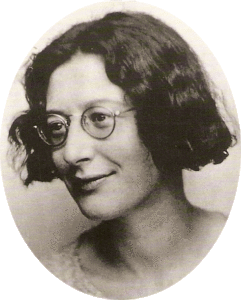 Weil and Ellul had prescient insights on a contemporary trend, namely an unbridled faith in technology, or what Ellul called “technique,” looming large. Ellul and Weil both present a case for how the method of the technological imagination undermines basic needs and obligations for human beings. Alan Jacobs’ text discusses both Weil and Ellul in this light. For Weil the enemy of education is “technocracy . . . ’evil [dominates] wherever the technical side of things is…sovereign.” For Ellul, observing later in the 20th century, “education no longer has a humanist…value in itself; it has only one goal, to create technicians.” Combining these reflections from the two authors, postmodernity and techniquelose touch with what Weil calls “attention”—waiting for God (or Platonist transcendent claims of Truth and Goodness), and also to the human other.
The thrust of technique in the contemporary American spheres of social media and education pulls away from critical and reflexive capacities, especially as core values in the liberal arts. These two related spheres of change suggest the unreflective assertion of ideas without in-depth, historical learning, or an ethically-entrenched humanistic approach. Higher education and wider communities of discourse reflect an age of empty speech and the worship of technological innovation and “the newest.” This moves away from the charism of St. Bernard of Chartres who reminds us that “New knowledge is always standing on the shoulders of giants.”
Source: International Jacques Ellul Society (2022) / / An early version of this article was presented at the American Weil Society colloquy in the Spring of 2017 at Villanova University.
Sarah MacMillen is an associate professor at McAnulty College and Graduate School of Liberal Arts in the Sociology Department at Duquesne University.
